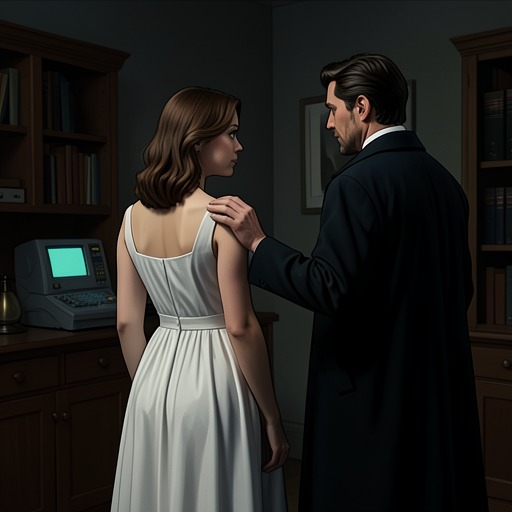
Millie wakes to find herself locked in the attic
The HousemaidMillie wakes to find herself locked in the attic after spending the night there with Andrew. The discovery reverses the apparent intimacy of their night: what had been a cramped room they shared becomes a space she cannot leave. The scene ends not with an explanation of who locked the door, but with Millie recognizing that its resistance is deliberate.
Circumstances
In Chapter 37, Millie and Andrew make love in the attic room, and she falls asleep wrapped in his arms on the cot. The cot is markedly less comfortable than the guestroom mattress, and Millie had not expected to have sex in a room where Nina had been strict about allowing guests. Her wry recognition that Nina’s rule has not worked out well for Nina gives the encounter a note of transgression, but Millie initially treats the attic as a place she is about to leave: she believes it is her last night sleeping there.
Around three in the morning, Millie wakes with a full bladder and realizes that Andrew is no longer beside her. She supposes he has moved to his own bed after finding the cot too uncomfortable for two people. The explanation seems plausible to her: the room is claustrophobic, the mattress is difficult even for one person, and Andrew is more than ten years older than she is. Still half within that ordinary interpretation, she considers using the bathroom and then joining him downstairs.
The Door and the Realization
Millie gets up and reaches the door. Its knob usually sticks, so she first treats the resistance as familiar inconvenience and turns it more firmly. When it still will not turn, her uncertainty becomes panic. She presses herself against the door, and its scratch marks catch against her shoulder as she tries the knob again with her right hand, turning it clockwise. It does not move even a millimeter.
The sequence makes the recognition a small but decisive reversal. At first, Millie expects a stubborn mechanism; repeated effort rules out that explanation. She understands that the door is locked. The door’s familiar tendency to stick has masked the change, delaying her recognition until physical pressure and an immovable knob make the difference unmistakable.
Consequence and Narrative Significance
The locked door overturns Millie’s immediate plan to leave the attic, use the bathroom, and perhaps find Andrew downstairs. The intimate scene and her assumption that Andrew has simply gone to his own bed give way to confinement, without establishing who locked the door or when it happened. The sharp transition from shared sleep to isolation makes the room’s material limits newly urgent: the cot, the cramped space, the marked door, and its immovable knob are no longer merely uncomfortable features of a bedroom.
The chapter break intensifies the turn. Millie’s discovery that she cannot open the door is followed by the Part II marker, leaving the reader at the instant her understanding of the room changes. The event’s force rests on that narrow shift: she had imagined the attic as a place she was leaving for the last time, but now finds herself unable to leave at all.